Nature & Healing
The Forgotten Medicine of Standing Still
July 11, 2026 · 6 min read
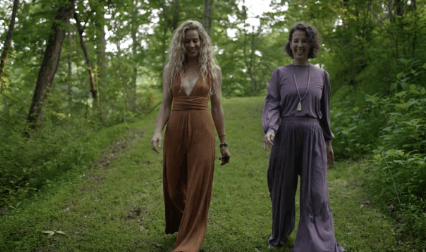
"A gentle guide to forest bathing — and why the land knows how to heal you, even when you've forgotten how to let it."
There is a Japanese phrase — shinrin-yoku — that translates to "forest bathing." It sounds like something you'd need special equipment for. A guide. A plan. A wellness membership.
It's none of those things.
Forest bathing is simply this: being in the presence of trees, slowly, with your senses open and your phone away. No hiking to a summit. No counting steps. No arriving anywhere. You walk, or you sit, or you stand — and you let the forest do what forests have always done to human nervous systems, long before we had a word for it.
I didn't learn this in a book. I learned it on fifteen acres in the Blue Ridge Mountains, on the days I was too tired to do anything but stand under the trees and breathe.
Why It Works — and It Isn't Poetry
Here's the part that surprised me: forest bathing isn't just a feeling. It's measurable.
When you spend unhurried time among trees, your body changes. Your cortisol — the stress hormone that runs high in most of us, most of the time — drops. Your heart rate slows. Your blood pressure eases. Trees release compounds called phytoncides, and breathing them in has been shown to boost the immune system for days afterward.
Your nervous system, which spends its days braced against traffic and screens and the low hum of too much to do, finally receives the one signal it's been waiting for: you are safe now. You can rest.
We were never meant to heal under fluorescent light. Something in us knows this. Something in us softens the moment we're held by trees.
The forest asks nothing of you. That, alone, is medicine.
What Gets in the Way
If it's so simple, why don't we do it?
Because we've forgotten how to be somewhere without doing something. We take the walk, but we take it fast, with a podcast in our ears and a destination in mind. We sit outside, but we sit with the phone. We are in nature, but we are not with it — our attention is still indoors, still scrolling, still solving.
Forest bathing asks for the one thing we've become terrible at: presence. Not productivity. Not a goal. Just being here, in this body, under these trees, for no reason at all.
That's harder than it sounds. And it's exactly why it heals.
How to Begin — Wherever You Are
You don't need a forest in the Blue Ridge. You need trees, a little time, and the willingness to slow down. Here is how I'd invite you to start.
Leave the phone behind — or silence it, deeply. Not face-down in your pocket. Off, or in the car. The forest can't reach you if part of you is still waiting for a notification.
Walk slower than feels natural. Half your normal pace. Then half again. You are not going anywhere. The slowness is the point — it's what lets your senses catch up to your body.
Open one sense at a time. Notice five things you can see. Then close your eyes and find five things you can hear — birdsong, wind, the creek, the small sounds beneath the big ones. Then what you can smell. Then the feel of the air on your skin. This isn't a technique. It's just a way of arriving.
Find a place to simply sit. Ten minutes. Longer if you can. Let the forest forget you're there. The birds will return. The light will shift. And something in you — the part that's been holding it all together — will begin, quietly, to let go.
Notice what rises. Often, when we finally stop, the thing we've been outrunning catches up. Grief. Tiredness. A tenderness we didn't know we were carrying. Let it come. The forest is a good place to feel things. It has held far older sorrows than yours.
The Return
You will not leave the trees a different person. That's not how it works.
But you may leave a little more yourself — a little slower, a little softer, a little more here. And if you do it again, and again, something accumulates. The nervous system learns a new baseline. The body remembers a rhythm older than your schedule: sunrise, birdsong, the slow turn of the seasons.
This is the oldest medicine there is. It costs nothing. It's waiting in every stand of trees you've walked past too quickly.
At Munaya, we've built a whole sanctuary around this simple truth — the forest trails, the fire, the open sky, the fifteen acres that do what no room and no protocol can. But you don't need us to begin. You only need to find some trees, put down your phone, and remember how to stand still.
The land knows how to heal you.
It's only waiting for you to slow down enough to let it.
— Saloua